The simplest way to understand peptides
Amino acids are the alphabet. Peptides are the words. Proteins are the sentences. Your skin is full of proteins, collagen, elastin, keratin, and those proteins are long chains made from amino acids.
A peptide is a shorter chain. Two amino acids make a dipeptide. Three make a tripeptide. Four make a tetrapeptide. Once the chain gets long enough, usually around 50 amino acids or more, you're talking about a protein instead of a peptide.
That size difference matters. You cannot rub full collagen onto your face and expect it to rebuild your dermis. A well-designed peptide is smaller, easier to formulate, and better suited to targeted topical support.
Why peptides became skincare ingredients
Peptides became interesting to formulators because skin is constantly sending and receiving biochemical signals. When skin repairs itself, breaks down damaged proteins, builds new matrix, or responds to irritation, small fragments and messenger molecules help coordinate the process.
Some cosmetic peptides are designed to resemble those fragments. The idea is not "this peptide becomes collagen." The better explanation is: this peptide may behave like a message skin already understands. That message can be tied to the appearance of firmer, smoother, calmer, brighter, or more refreshed skin, depending on the peptide.
That is also why the word "peptide" by itself does not tell you much. A peptide is a format, not a benefit. The named ingredient and the use case matter more than the category.
The main types of skincare peptides
The honest answer is: it depends on the peptide. Most skincare peptides fall into a few useful categories:
- Signal peptides are fragments that look like messages your skin already recognizes. They are usually used for the look of firmness, bounce, smoother texture, or improved barrier comfort. Matrixyl 3000 is the classic example.
- Carrier peptides bind to and carry another element. The most famous is GHK-Cu, a copper peptide studied for skin renewal, texture, and barrier support.
- Calming peptides are designed around visible irritation pathways. Palmitoyl Tripeptide-8, for example, is tied to the look of reduced redness and reactive skin.
- Brightening peptides can be used around the pigment pathway. Oligopeptide-68 is a well-studied example for uneven tone and post-blemish marks.
- Depuffing peptides are used for the look of fluid-related under-eye puffiness. Acetyl Tetrapeptide-5 is the ingredient to know here.
- Neurotransmitter-affecting peptides interact with expression-line signaling. Argireline is the best-known example. We do not formulate around it because the at-home topical evidence is less useful than the marketing suggests.
What peptides do not do: rebuild collagen the way an injection would, replace sunscreen, erase deep wrinkles overnight, or make a weak formula strong just because "peptide complex" appears on the front of the box.
The peptides worth knowing
These are the peptides we think are most worth understanding because they have clearer use cases and show up across the better end of the skincare aisle.
- Matrixyl 3000 is a blend of Palmitoyl Tripeptide-1 and Palmitoyl Tetrapeptide-7. Think of it as the firming and cushion peptide family: best for the look of fine lines, creasing, and skin that feels less springy than it used to.
- GHK-Cu, listed as Copper Tripeptide-1, is the copper peptide with the deepest reputation. It is used for the look of renewed skin, refined texture, and stronger-feeling barrier support.
- Palmitoyl Tripeptide-8 is a calming peptide modeled around alpha-MSH pathways. It is useful when the goal is less visible redness, less reactivity, and a more comfortable-looking barrier.
- Oligopeptide-68 is a brightening peptide tied to tyrosinase-related pigment signaling. It is typically used for dark spots, uneven tone, and post-blemish marks, often alongside niacinamide and tranexamic acid.
- Acetyl Tetrapeptide-5 is a targeted under-eye peptide. Its use case is not dark circles from pigment or shadows from bone structure; it is the look of puffiness, especially the morning kind.
- Retinyl-Peptide Complexes pair a retinoid step with peptide support. This is useful when you want a smoother-looking overnight routine but do not want the feel of a harsh, stripped-down retinoid product.
The quick matching guide
Fine lines or less bounce: Matrixyl 3000.
Skin that looks tired or uneven in texture: GHK-Cu.
Red, stressed, reactive skin: Palmitoyl Tripeptide-8.
Dark spots or post-blemish marks: Oligopeptide-68.
Morning under-eye puffiness: Acetyl Tetrapeptide-5.
Texture plus nighttime renewal: a retinal and peptide blend.
How to read a peptide label
The front of a product can say almost anything. The ingredient list is where the formula has to get more honest. Here is how to read it.
- Look for the named peptide. "Peptide complex" is not enough. "Palmitoyl Tripeptide-1," "Palmitoyl Tetrapeptide-7," "Copper Tripeptide-1," "Oligopeptide-68," or "Acetyl Tetrapeptide-5" are real INCI names you can evaluate.
- Check where it appears. INCI lists are ordered by concentration until ingredients drop below 1%, then the order becomes more flexible. Peptides are often effective at low levels, so they do not have to be first, but they should not feel like an afterthought below fragrance and preservatives.
- Read the support system. Peptides usually perform best in formulas with humectants, lipids, and barrier-friendly ingredients. Glycerin, sodium hyaluronate, squalane, ceramides, panthenol, shea, and similar ingredients help make the formula wearable enough for daily use.
- Match the claim to the peptide. A product using Acetyl Tetrapeptide-5 should not be promising collagen rebuilding. A product using Matrixyl 3000 should not be positioned as the main dark-spot treatment. The best formulas make claims that match the ingredient's real lane.
Green flags and red flags
Green flags: the peptide is named, the claim is specific, the formula includes hydration and barrier support, and the brand explains the use case without promising an instant face transplant.
Red flags: "10 peptides" with no explanation, a peptide hidden at the very end of a long fragrance-heavy list, before-and-afters that imply overnight structural change, or language that makes peptides sound like topical filler.
What results should you expect?
Peptides are consistency ingredients. The people who get the most from them are usually not the people using a different active every night; they are the people who pick the right peptide for the right job and repeat it long enough to see a pattern.
For under-eye puffiness, the visual window can be shorter because fluid-related puffiness can shift faster. For calming and barrier comfort, you may notice the skin feels less annoyed before it looks dramatically different. For firmness, lines, tone, and texture, think in 8-to-12-week windows, not days.
It also helps to judge the right thing: brightening peptides for tone, firming peptides for bounce, calming peptides for visible reactivity.
How peptides fit with the rest of your routine
Peptides are usually easy to layer. They do not make skin photosensitive the way retinoids can, and most do not require the careful tolerance ramp that exfoliating acids or prescription retinoids do. That is why they are useful in routines that already contain stronger actives.
If you use retinol, peptides can sit in the morning or on off-nights. If you use vitamin C, most peptides are fine in the same general routine, though copper peptides are best separated from strong acidic vitamin C formulas. If you use exfoliating acids, keep the acid as the exfoliating step and use peptides for recovery and targeted support.
For a deeper breakdown, we wrote a full comparison of peptides vs. retinol and a practical guide on how to layer a targeted skincare stick.
How Peptide Sticks uses them
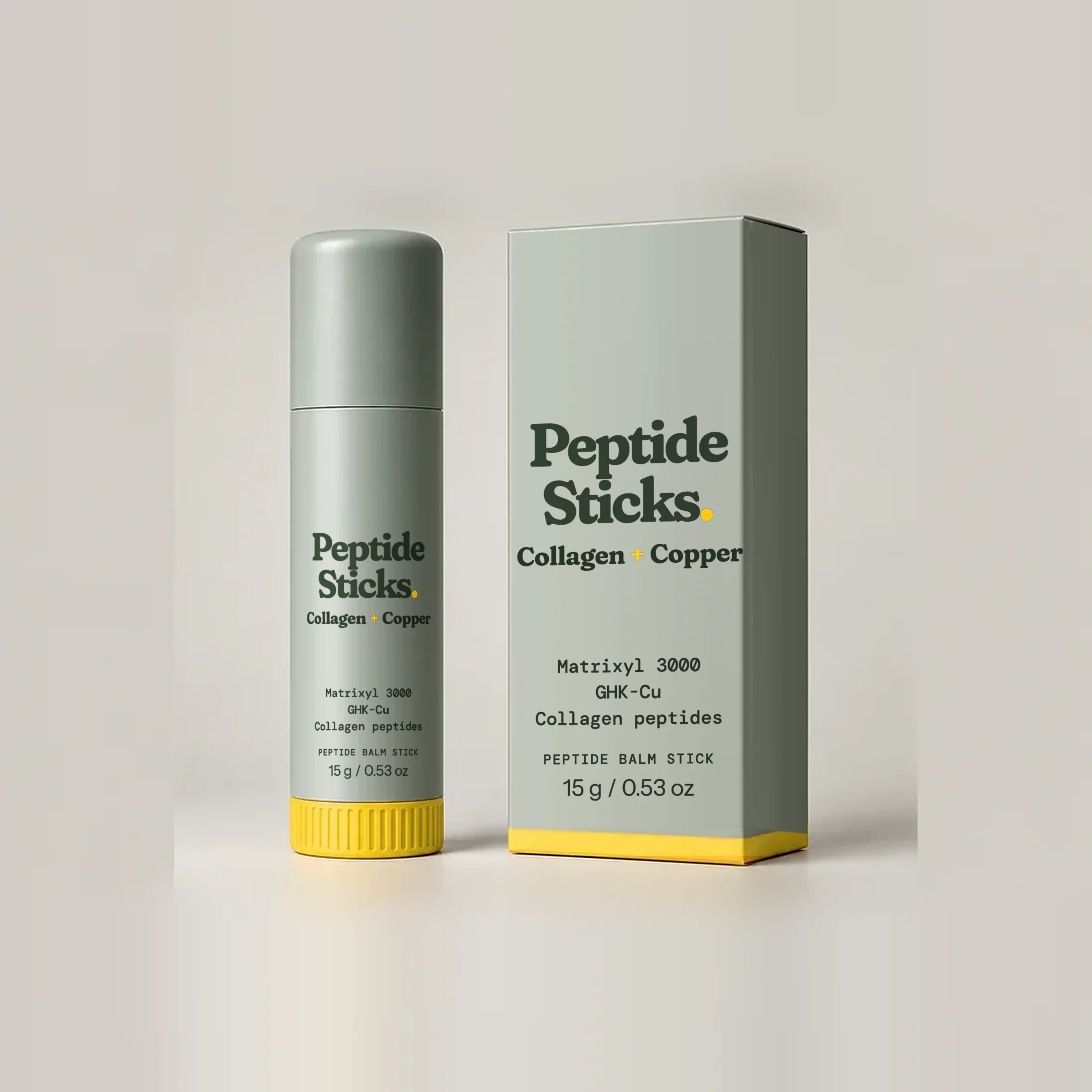
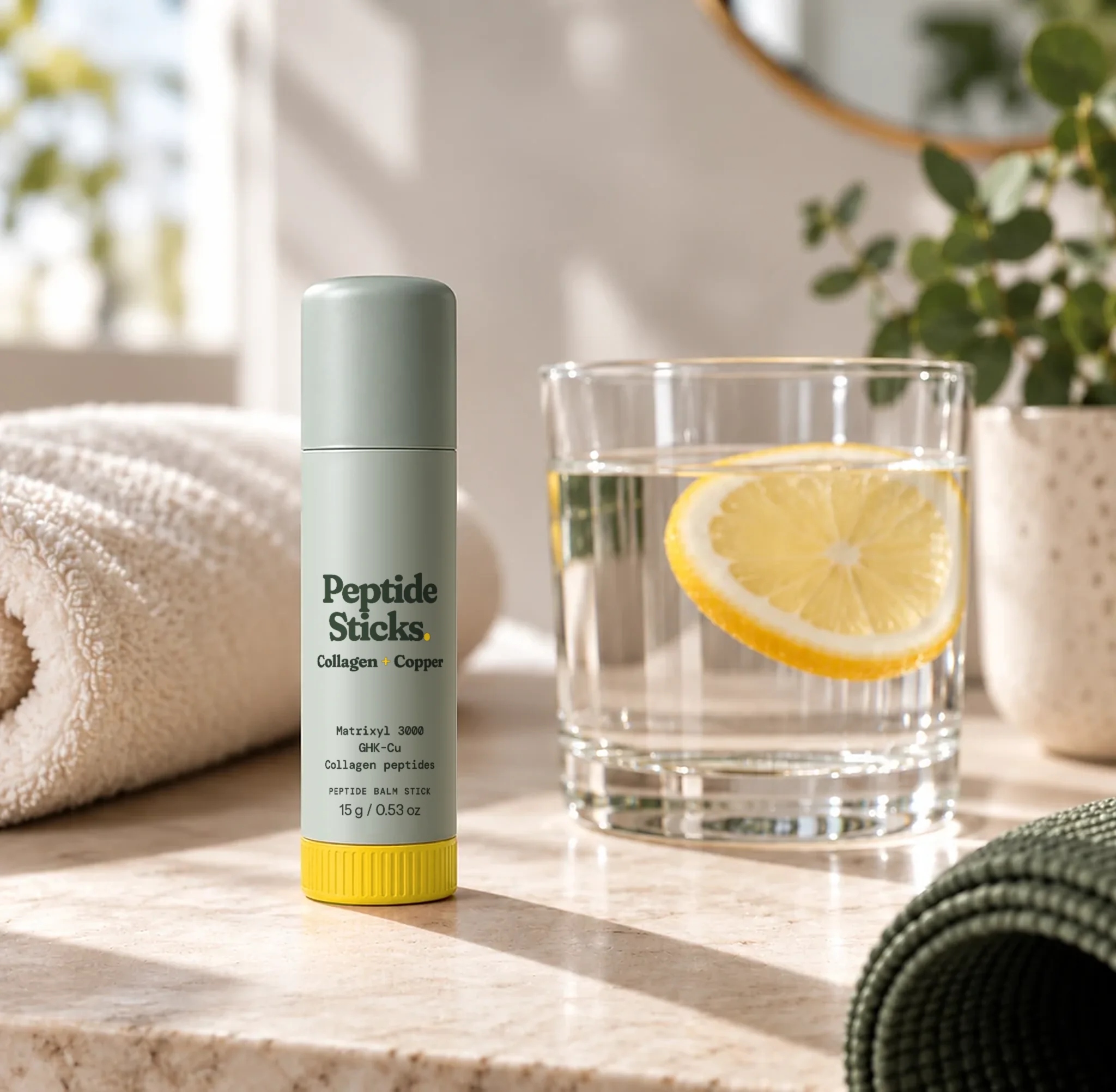
Our first stick, the Collagen + Copper Stick, pairs a focused peptide formula with one clear skin goal. We prefer that to the "everything serum" approach because every ingredient should have a job.
It features Matrixyl 3000, collagen peptides, and GHK-Cu for the look of firmer, smoother, denser, more cushioned skin.
The stick format is mostly about making consistency easier. A clear, water free base carries the peptide; the twist-up format lets you swipe it exactly where it belongs, without over-applying an active to your whole face.
The bottom line
Peptides are not magic, but they are not marketing fluff either. The useful middle ground is this: named peptides can be excellent targeted ingredients when they are matched to the right skin goal, formulated in a supportive base, and used consistently.
Ignore vague "peptide complex" language. Pay attention to the specific peptide, the claim, the supporting ingredients, and the time frame. That is where the value is.