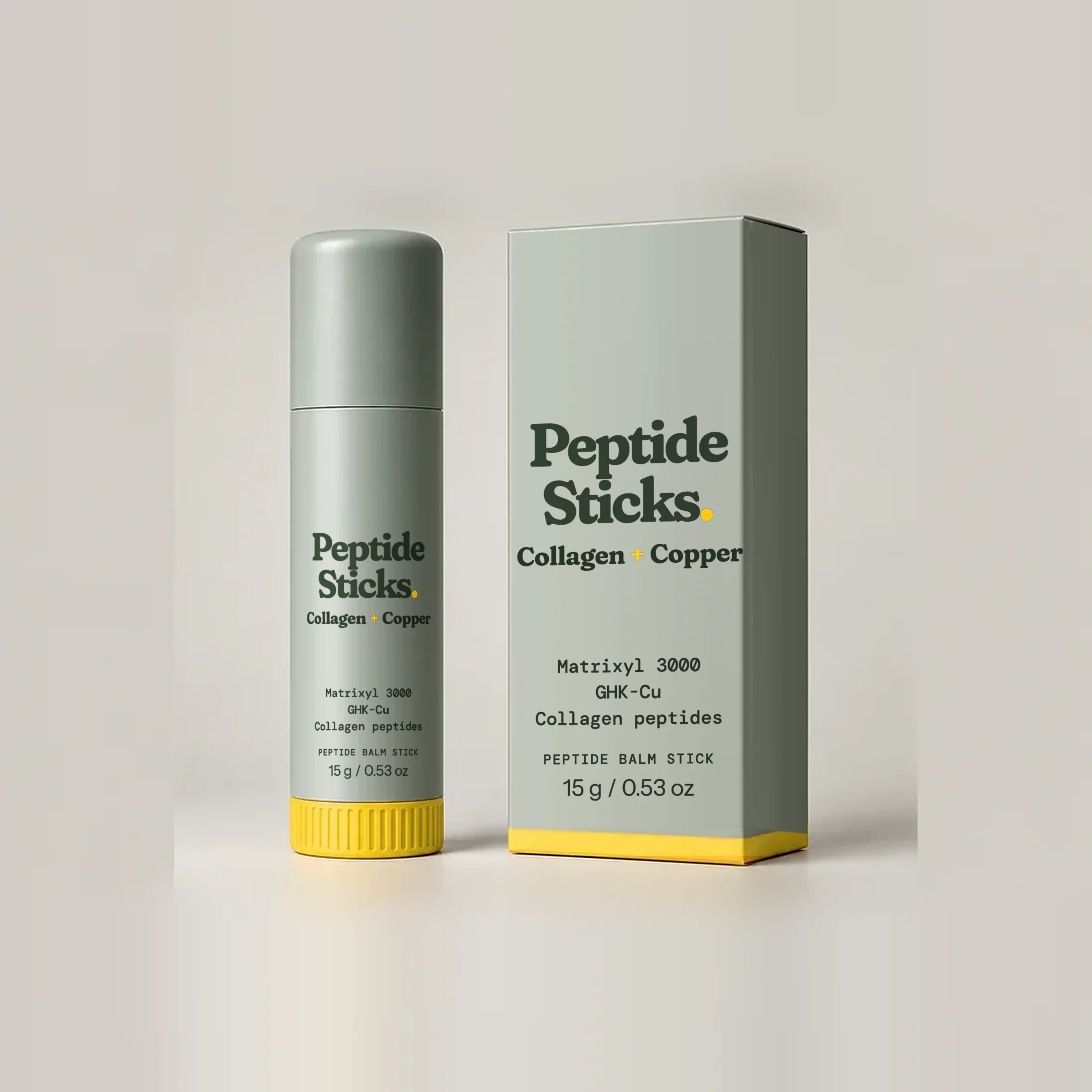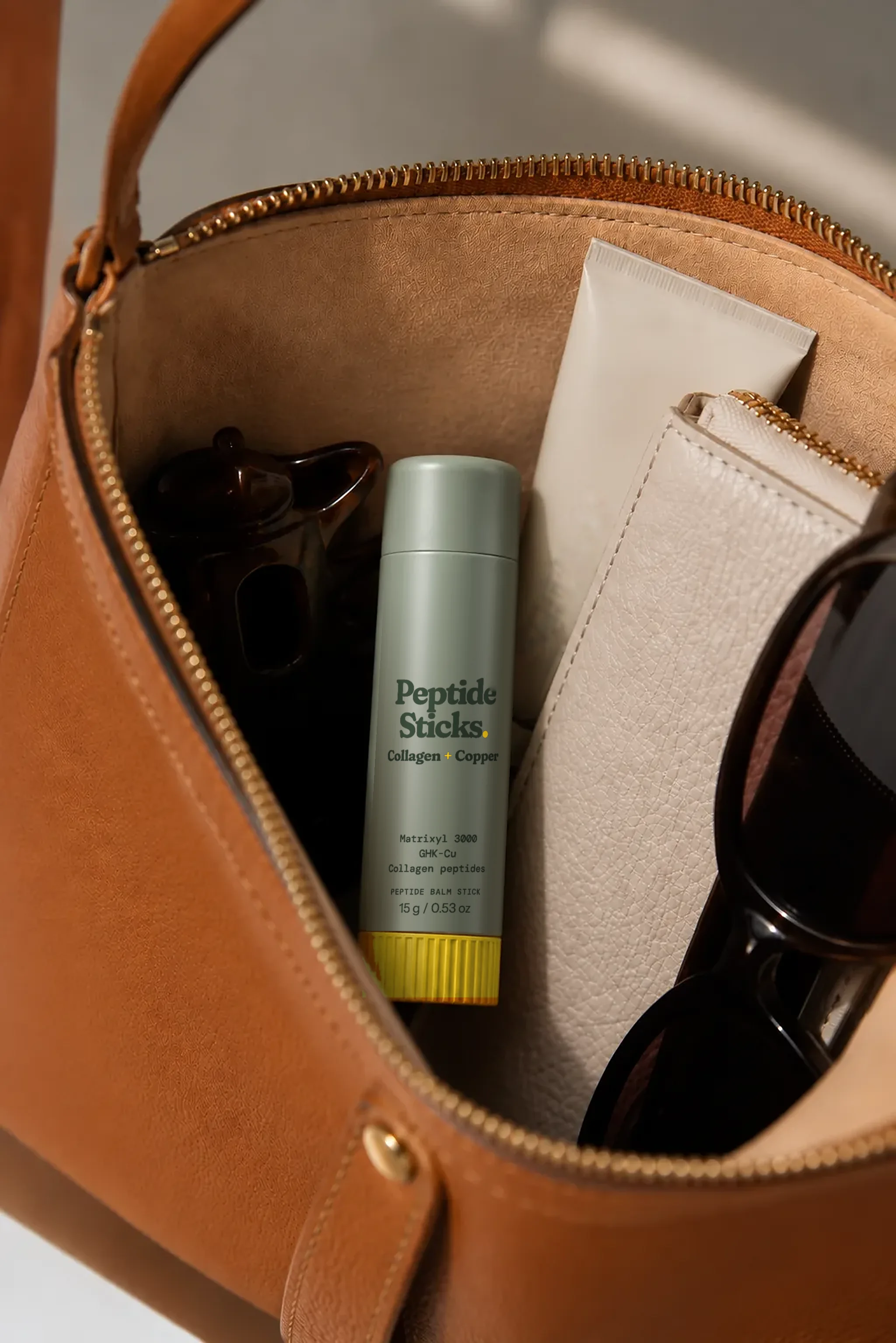
What is a peptide balm stick?
A peptide balm stick is a solid, twist-up skincare balm that delivers topical peptides without water. You twist it up and swipe it straight onto skin, so the actives land on the area you are treating rather than being spread thinly across a whole face that may not need them. Because there is no water phase, the base can carry peptides with a lighter preservative system than a lotion or a bottled serum requires.
That is the whole idea in one sentence. The rest of this page is about why the format matters and how to tell a considered one from a tube of scented wax.
Why put peptides in a balm at all
Three reasons, and they are all practical rather than romantic.
- Placement. Peptides are expensive per gram, and most people do not need the same treatment on the forehead, the jaw, and the neck. A stick lets you put a concentrated dose on smile lines and skip the areas that are already fine. A pump bottle cannot do that.
- Stability without a heavy preservative system. Water is what microbes need. Take the water out and the formula gets simpler and more forgiving, which is useful when you are carrying delicate ingredients like GHK-Cu.
- Occlusion. A balm sits on skin and cushions it. That finish is not just a feel, it slows water loss from the surface, which is part of why balm formats read as comforting on dry or wind-stripped skin.
The format in one line
A serum asks you to spread actives across your face.
A balm stick asks you where you actually want them.
Peptide balm stick vs. peptide serum stick
These two terms get used as synonyms on a lot of product pages, and honestly the line is blurry. The useful distinction is finish, not function.
- A balm stick leans richer. It leaves a cushioned, slightly occlusive layer, which suits dry skin, cold weather, the neck, and the chest, and makes it a natural last step.
- A peptide serum stick is engineered to feel lighter and vanish faster, so you can layer moisturizer, SPF, or makeup over it without pilling.
Neither is automatically stronger. Texture tells you how something feels; the ingredient list tells you what it does. We wrote a full breakdown if you want the detail: balm stick vs. serum stick.
The melt question, which is the real question
If you read reviews of balm sticks, one complaint dominates: it went soft. A stick that sweats in a bag, slumps in a car, or arrives with a glossy film on top is telling you something about the base. Most balm sticks are held together by butters and waxes with a low melt point, which is cheap, pleasant on skin, and fragile at anything above room temperature.
This is a formulation choice, not a law of physics. A stick can be built on a heat stable base instead, one that holds its shape through summer shipping and a gym bag and still glides when you twist it up. If you are comparing products, ask whether the brand has cycled the formula through heat and cold and can say so plainly. It is the single most useful thing you can know about a stick before buying it.
What to look for on the label
- Named peptides, not "peptide complex." Matrixyl 3000 and GHK-Cu have real published work behind them. A proprietary blend with no names behind it is a marketing decision.
- Peptides high in the list. If the named peptide sits below the fragrance, you are buying mostly base.
- A base you can identify. Heat stable, non-comedogenic, and described honestly.
- No fragrance, if you can avoid it. A product you press into smile lines and around the eye area is the wrong place to add an irritant for the sake of scent.
- Clear rather than tinted, unless you specifically want a tint. Clear means it layers under makeup and works for anyone.
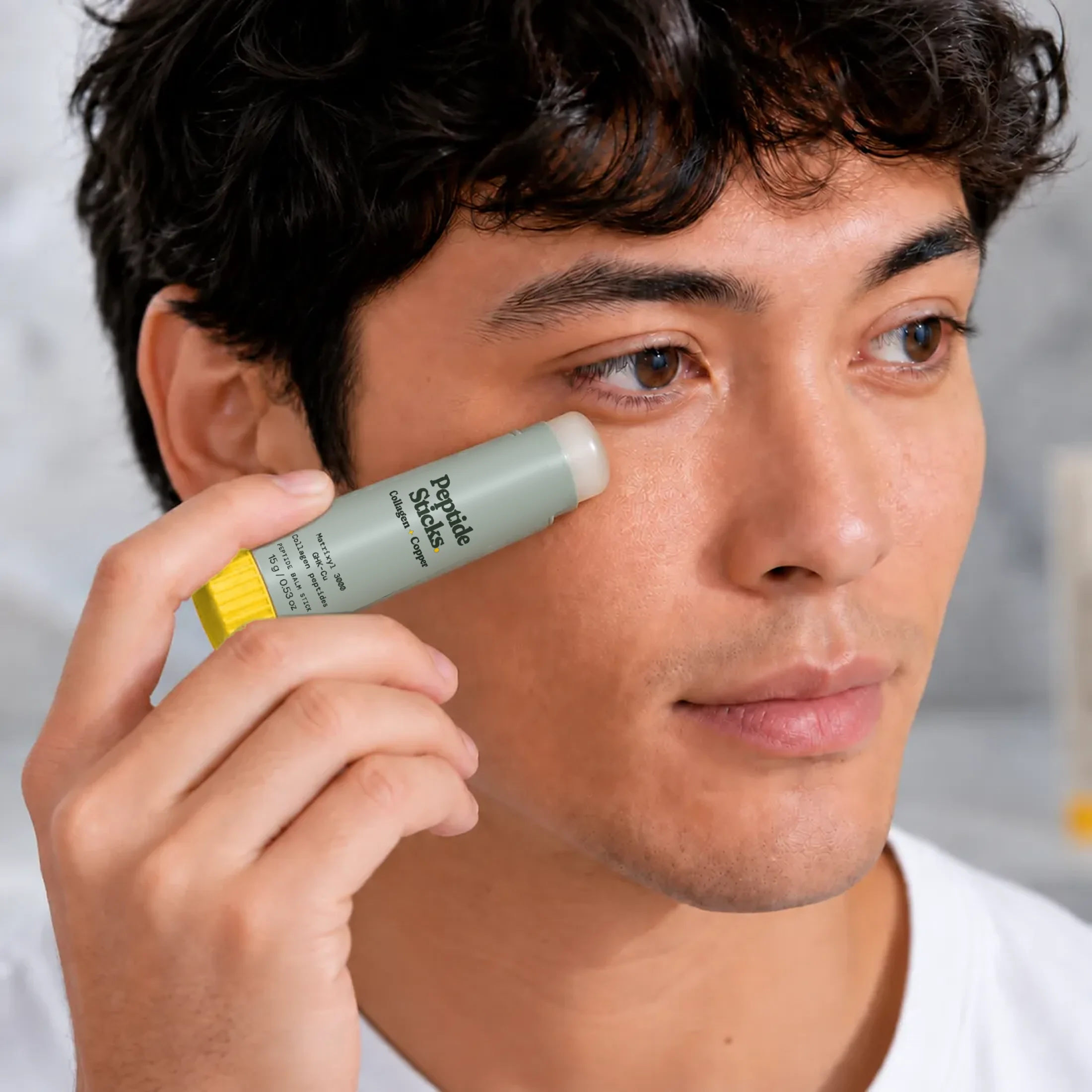
How to use a peptide balm stick
- Cleanse and leave skin slightly damp. Balm glides better and spreads further on skin that is not bone dry.
- Twist up a few millimeters. Less than you think. The stick should last months, not weeks.
- Swipe once over the area you are treating. Smile lines, forehead, jaw, the front of the neck, the chest, the backs of the hands.
- Press it in with clean fingertips. Do not rub. Pressing warms the balm and settles it without dragging skin.
- Follow with moisturizer, then SPF in the morning. A balm stick is a treatment step, not a sunscreen.
- Use it daily and photograph the starting point. Same light, same angle. Skin memory is unreliable and cameras are not.
For the full routine order, including where a stick goes relative to retinoids and acids, see how to layer a targeted skincare stick.
Which peptide for which concern
The word peptide covers a lot of ground. Match the named ingredient to what you want to change:
- Firmness and fine lines: Matrixyl 3000, the most studied signal peptide for the look of firmness.
- Renewal and barrier: GHK-Cu copper peptides, with a long research history behind them.
- Visible calm in reactive skin: Palmitoyl Tripeptide-8.
- Uneven tone: Oligopeptide-68.
- Under-eye puffiness: Acetyl Tetrapeptide-5.
If you are still deciding, our guide to which peptide suits which concern walks through it properly.
What a peptide balm stick will not do
We would rather be straight about this. A balm stick will not out-resurface a well-tolerated retinoid, and it does not replace sunscreen, which is still the highest-value step in any routine. Peptides are gradual, supportive ingredients for the appearance of skin, not overnight structural change. If a stick promises to erase wrinkles by the weekend, the promise is the problem, whatever format it comes in. The honest version of the case for peptides is in do peptides actually work.
The bottom line
A peptide balm stick is a genuinely good idea when it is made seriously: water free, precisely placed, comfortable, and built on a base that survives a real bag on a real day. Buy it for the named peptides and the base, not for the format alone, give it eight to twelve weeks, and keep the rest of the routine boring.