What is peptide skincare?
Peptide skincare is any serum, cream, eye cream or stick built around peptides: short chains of amino acids, the same building blocks that make up collagen, elastin and keratin. Two amino acids make a dipeptide, three a tripeptide, and somewhere around 50 the chain becomes a protein.
That size matters. You can’t rub collagen onto your face and have it rebuild anything; the molecule is far too large. A small, well-designed peptide is a different idea. It behaves like a message skin already understands, and the message can be “make more collagen,” “bring in copper,” or “calm down.”
So “peptide” on its own tells you very little. It’s a format, not a benefit. The named peptide, and how much of it is in the formula, is what decides whether a product does anything.
What do peptides do for skin?
The well-studied peptides have shown, in published trials, that skin can look firmer, smoother and less lined after 8 to 12 weeks of daily use. The main jobs:
- Firmness and fine lines. Signal peptides such as Matrixyl 3000 are linked to more collagen and a bouncier look.
- Texture and renewal. GHK-Cu copper peptides support the skin’s own renewal and a stronger-feeling barrier.
- Calm. Palmitoyl Tripeptide-8 is used for visible redness in reactive skin.
- Tone. Oligopeptide-68 targets dark spots and post-blemish marks.
- Puffiness. Acetyl Tetrapeptide-5 is the under-eye peptide.
- Collagen support from food-style peptides. Collagen peptides in a topical formula mostly hydrate and cushion the surface.
What peptides don’t do: fill deep wrinkles, lift sagging skin the way a procedure does, or replace sunscreen.
Peptide skincare benefits, in one list
Firmer and smoother looking skin over 8 to 12 weeks. Fewer visible fine lines. Gentle enough for daily use and sensitive skin. Layers with almost everything else on your shelf. Safe to use morning and night. All seven, with the research behind each: peptide skincare benefits, ranked by evidence.
Do peptides actually work?
Some do, and the difference between brands is mostly which peptide and how much. Matrixyl 3000 and GHK-Cu have the deepest research, including controlled trials on human skin. Argireline is the most marketed and has some data, but its effect from a cream is modest compared with the “topical Botox” nickname.
Two honest caveats. Many studies are small, and many are funded by the companies that sell the ingredient. And a study of an ingredient is not a study of a finished product. That’s why we tell people to judge a peptide product on its named peptides, its place in the ingredient list, and their own before-and-after photos. The longer answer is in do peptides actually work.
How to choose a peptide product
- Find the named peptide. Palmitoyl Tripeptide-1, Palmitoyl Tetrapeptide-7, Copper Tripeptide-1, Acetyl Tetrapeptide-5. “Peptide complex” with no names is a marketing choice.
- Check where it sits. Peptides work at low levels, so they needn’t be first. But a peptide listed after the fragrance is a rounding error.
- Match the peptide to your concern. Firming peptides for lines, Acetyl Tetrapeptide-5 for puffiness, Oligopeptide-68 for spots. Our peptide finder does this in a minute.
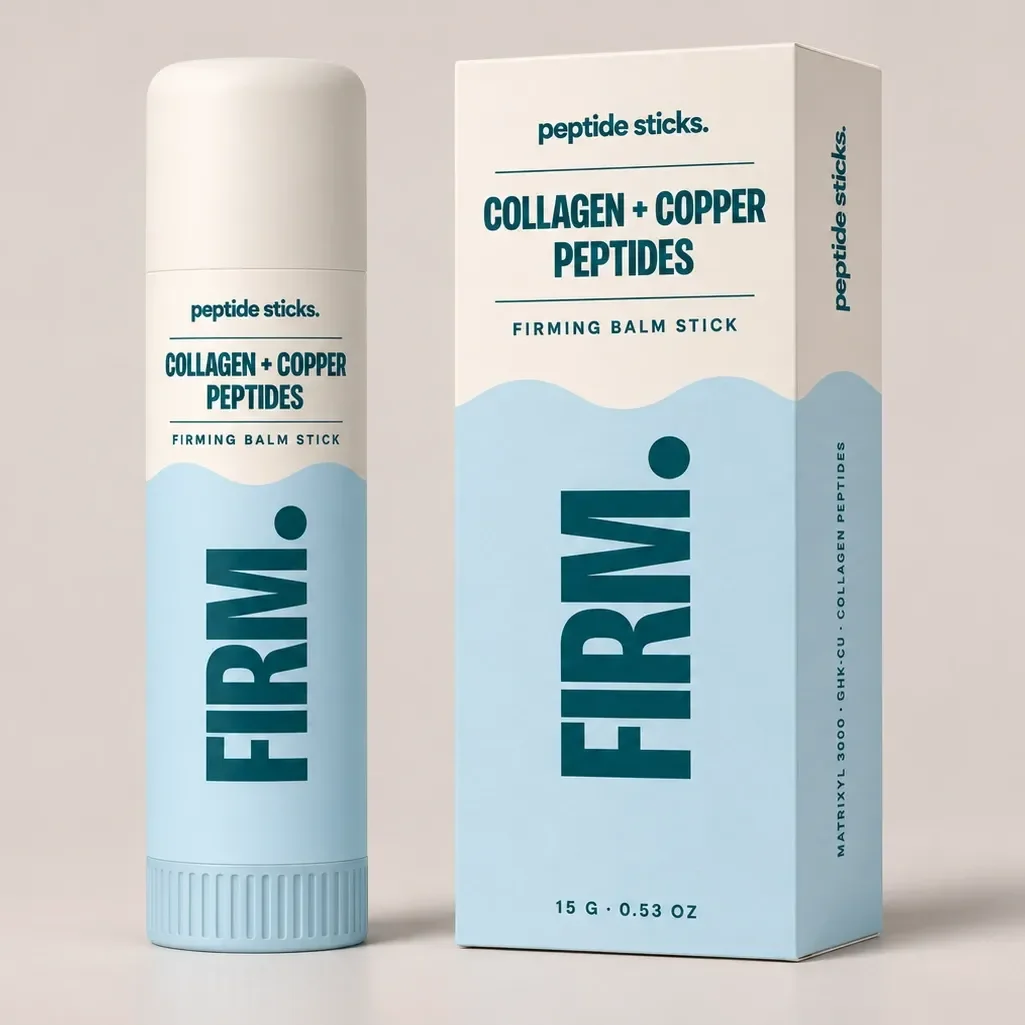
- Pick the format by where you need it. A serum or moisturizer for all-over care; a peptide stick to target smile lines, the jaw and neck.
- Skip added fragrance. You’ll use it every day, often on thin skin.
A simple peptide skincare routine
Morning: rinse or cleanse, peptides, moisturizer, SPF 30+. If you use vitamin C in the morning, keep copper peptides for the evening.
Night: cleanse, peptides, moisturizer. On retinol nights, use the retinol as usual; peptides sit comfortably alongside it, or take the off-nights so every night isn’t a high-intensity one.
Thin layers, pressed in, with a minute between steps, prevent most pilling. The full order, with acids and retinoids, is in how to layer peptides.
Peptides vs. retinol vs. vitamin C
Retinol is still the strongest over-the-counter tool for texture and lines, but it can sting, peel and flake. Vitamin C is the morning antioxidant for brightness. Peptides are the gentle daily support that goes with both. If your skin can’t handle retinol, peptides are the closest gentle alternative; if it can, use both. The full comparison: peptides vs. retinol. Curious about PDRN? See PDRN vs. peptides.
Peptide skincare for men
Peptides are a good fit for men: gentle on shaved skin, no peeling, and easy to add to a two or three step routine. The usual targets are forehead lines, crow’s feet and the jawline. Start with a simple routine for men, and read GHK-Cu for men for the copper peptide specifically.
The bottom line
Good peptide skincare is simple: a named, well-studied peptide, a formula without added fragrance, every day for three months, and sunscreen every morning. Everything else is packaging.