What peptides do, in one paragraph
Peptides are short chains of amino acids, the same building blocks as collagen and elastin. In skincare, the useful ones act as messages. Some tell skin cells to make more collagen, some carry copper that skin uses to renew itself, and a few aim to calm nerves or soften muscle-driven lines. They work at low concentrations, and many carry a fatty “palmitoyl” tail to help them get into the top layers of skin (Pai and colleagues, 2017; Schagen, 2017). That is why the benefits are real but gradual: you are asking skin to change how it behaves, not coating it.
The benefits at a glance
| Benefit | Best-studied peptides | Evidence | Time to see it |
|---|---|---|---|
| Fewer visible fine lines and wrinkles | Matrixyl (Palmitoyl Pentapeptide-4), Matrixyl 3000 | Strongest | 8 to 12 weeks |
| Firmer, more elastic looking skin | Matrixyl 3000, GHK-Cu | Good | 8 to 12 weeks |
| Smoother texture and clearer skin | GHK-Cu (Copper Tripeptide-1) | Good | 8 to 12 weeks |
| Better hydration and a stronger barrier | Collagen peptides, GHK-Cu | Some | Days to feel, weeks to build |
| Calmer, less reactive skin | Palmitoyl Tripeptide-8 | Early | 2 to 4 weeks |
| Softer expression lines | Argireline (Acetyl Hexapeptide-8) | Early | 4 weeks and up |
| More even tone and less puffy eyes | Oligopeptide-68, Acetyl Tetrapeptide-5 | Early | 2 weeks (puffiness) to 12 (tone) |
How we rank evidence. Strongest: placebo-controlled trials on human faces. Good: controlled human studies that are few or small. Some: a mix of human and lab data. Early: mostly studies run by the company that makes the ingredient.
1. Fewer visible fine lines and wrinkles
This is the benefit with the best evidence. In a 12-week, placebo-controlled split-face study of 93 women, a moisturizer with Palmitoyl Pentapeptide-4 (sold as Matrixyl) improved wrinkles and fine lines, both on measurement and in expert grading (Robinson and colleagues, 2005). Its successor, Matrixyl 3000 (Palmitoyl Tripeptide-1 and Palmitoyl Tetrapeptide-7), has more trials for lines and firmness. Reviews describe the results as real but modest, and note that many trials are small or funded by the ingredient’s maker (Gorouhi and Maibach, 2009; Lupo and Cole, 2007). More in our Matrixyl 3000 guide.
2. Firmer, more elastic looking skin
Skin makes less collagen as we age, and sun speeds that up. Signal peptides like Matrixyl 3000 tell fibroblasts, the cells that build skin’s support, to make more collagen and elastin. GHK-Cu copper peptides have been studied in facial creams for firmness, thickness and laxity over about 12 weeks (reviewed in Pickart and Margolina, 2018). Expect skin that looks firmer and bounces back a little better, not a lift.
3. Smoother texture and clearer skin
GHK-Cu is a copper peptide found naturally in the body, and its levels fall with age. Gene-expression research suggests it influences thousands of genes tied to skin renewal and protection, and small human studies report smoother, clearer looking skin (Pickart and colleagues, 2015). The lab evidence is deeper than the human evidence, so read it as encouraging. More in our GHK-Cu guide.
4. Better hydration and a stronger barrier
Applied to skin, collagen peptides are too large to reach the layer where collagen is made, but they hold water at the surface, so skin feels softer and smoother within days (Aguirre-Cruz and colleagues, 2020). Copper peptides are studied for supporting the skin barrier, though most of that data comes from the lab. In practice, peptides help a barrier routine; they don’t replace a moisturizer. More in our collagen peptides guide.
5. Calmer, less reactive skin
Palmitoyl Tripeptide-8 is a neuropeptide designed to quiet the signals that make skin flush and sting. The early results are promising, but the studies mostly come from the company that makes it. It suits sensitive skin and nights when you skip stronger actives. More in our Palmitoyl Tripeptide-8 guide.
6. Softer expression lines
Argireline (Acetyl Hexapeptide-8) aims at the muscle signals behind expression lines. A small early study reported shallower lines after 30 days (Blanes-Mira and colleagues, 2002). The effect from a cream is modest. It isn’t “topical Botox,” and no cream relaxes muscles the way an injection does.
7. More even tone and less puffy eyes
Oligopeptide-68 targets the pathway that makes pigment, so it’s used for dark spots and uneven tone. Acetyl Tetrapeptide-5 targets fluid that collects under the eyes. Both have supplier studies and few independent trials. See our guides to Oligopeptide-68 and Acetyl Tetrapeptide-5.
The quiet benefit: you’ll keep using it
Peptides rarely sting, peel or redden skin. That matters more than it sounds. Every benefit above needs 8 to 12 weeks of daily use, and the routine you can keep beats the stronger one you quit.
What peptides can’t do
Peptides don’t lift sagging skin, fill deep folds or restore volume lost with age or weight loss. They don’t work overnight. And they don’t replace sunscreen: in a randomized trial, adults who used sunscreen daily showed no detectable increase in skin aging over four and a half years (Hughes and colleagues, 2013). Peptides are the step that builds on that protection.
How to get the benefits
- Buy named peptides. Look for Palmitoyl Tripeptide-1, Palmitoyl Tetrapeptide-7 or Copper Tripeptide-1 on the label, not just “peptide complex.”
- Match the peptide to the goal. Lines and firmness: Matrixyl 3000 and GHK-Cu. Redness: Palmitoyl Tripeptide-8. Spots: Oligopeptide-68. Our peptide finder does this in a minute.
- Use it every day. Once or twice daily on clean skin, then moisturizer.
- Wear SPF 30 or higher. Every morning, or the sun undoes the work.
- Give it 12 weeks. Take a photo on day one in the same light, so you can judge fairly.
Peptides also pair well with a retinoid for people who want more. Peptides every day, retinol a few nights a week, is a common routine. See peptides vs. retinol.
Serum, cream or stick?
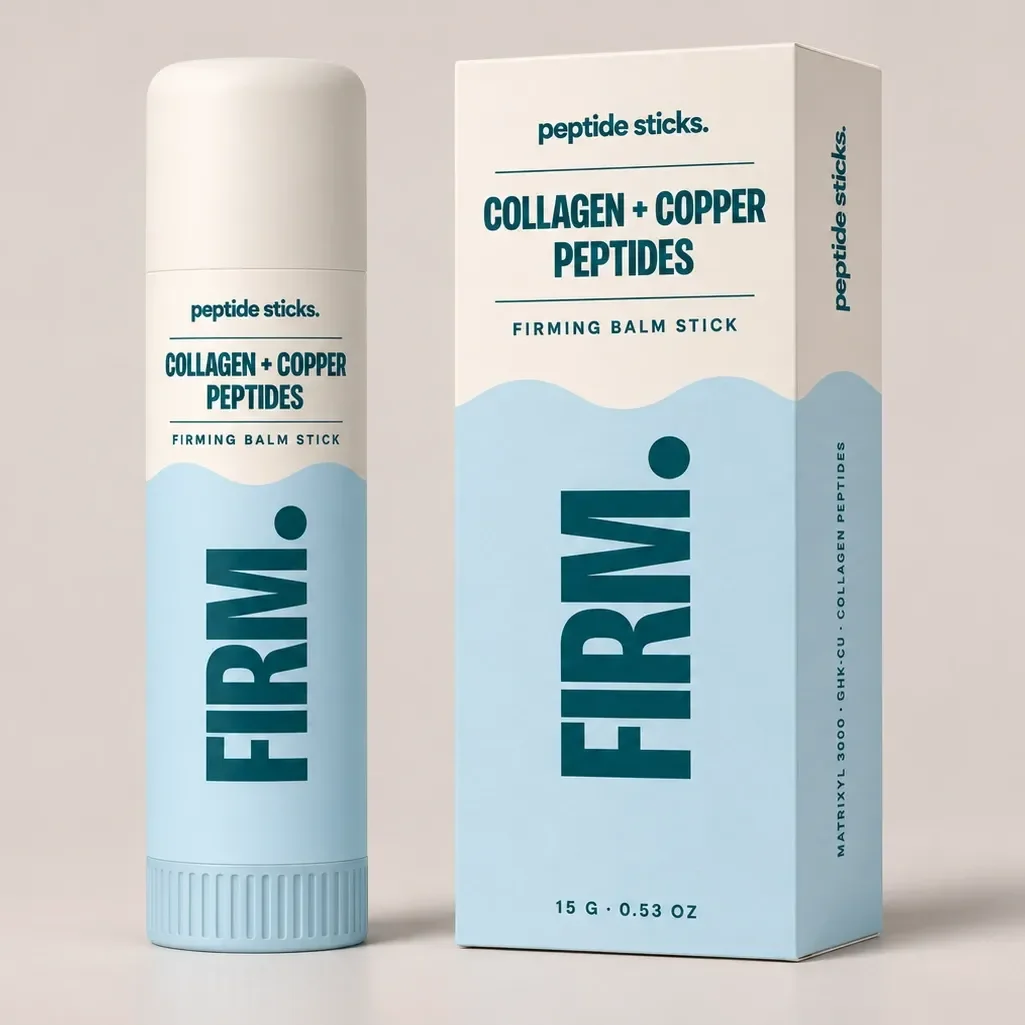
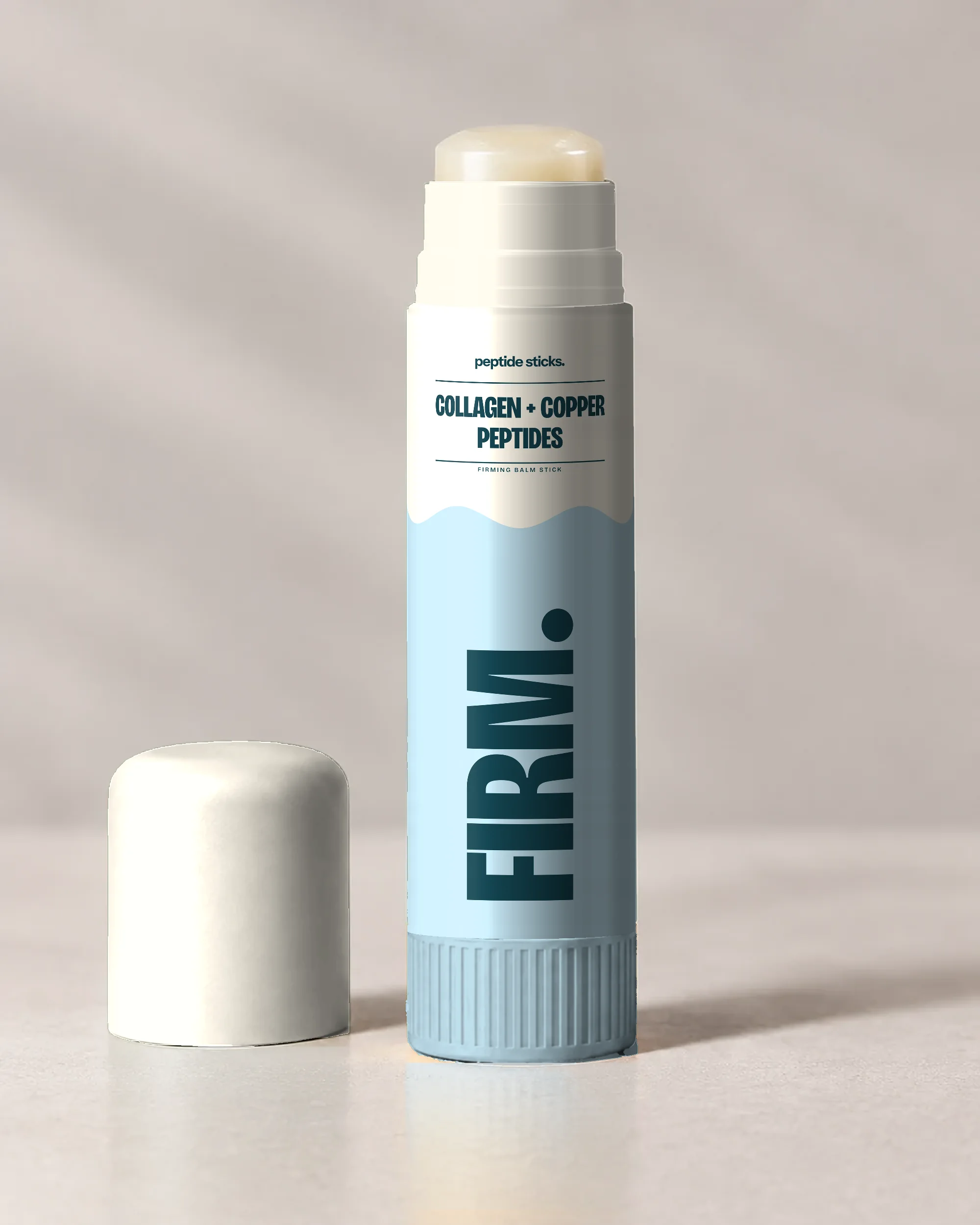
The benefits come from the peptides, not the format. Pick the format by where you need them. A peptide serum covers the whole face. A peptide cream adds moisture in one step. A peptide balm stick puts peptides exactly where lines show first: smile lines, forehead, jaw and neck.
Side effects, briefly
Peptides are among the gentlest actives. Irritation is uncommon and usually comes from the rest of the formula, such as fragrance or acids. Copper peptides can tingle and are best kept apart from strong vitamin C in the same step. The full list, and when to stop, is in peptide skincare side effects.
The bottom line
The benefits of peptide skincare are real, gradual and gentle. The strongest are fewer fine lines and firmer looking skin, backed by Matrixyl peptides and GHK-Cu. Choose a product that names its peptides, use it daily with SPF, and give it 8 to 12 weeks. For the bigger picture, start with peptide skincare, explained.